
Ongezellig
IAZ and soft NAZ
[Return] [Thread list] [Index] [Catalog] [Bottom] | Replies: 73 | Views: 75 | Currently viewing: 1
<Maya space
In an uniform population (not divided into subpopulations), the kinship between a person and his child is 1/4. Choose a locus and a gene at that locus in yourself, there is 1/2 chance the child inherited this gene from you (as opposed to inheriting the allele from the other chromosome), and there is 1/2 chance you have picked that gene in your child (as opposed to picking a gene that it inherited from its mother.)
<BWC space
If we take subpopulations into account and if the mother is from the same subpopulation as the father, the kinship with the child jumps to (1/4 + 3 F_{ST}/4). The reasoning is as follows: with probability 1/2 you pick the allele it inherited from you, then with probability 1/2 is the same allele you've picked initially and with probability 1/2 it's the other allele that comes from you, which in turn is identical to the first allele with probability (p_{same} = F_{ST} + (1 - F_{ST})p). And with probability 1/2 you pick an allele coming from the mother, who is from the same subpopulation as you, so the probability of it being identical is also (p_{same} = F_{ST} + (1 - F_{ST})p). Finally, you have (p_{child} = 1/4 + 3/4 (F_{ST} + (1 - F_{ST})p)). Kinship coefficient is equal to (F_{xy} = (p_y - p)/ (1 - p)) after transforming the first equation. Transforming (p_{child}) gives:
• (p_{child} = 1/4 + 3/4F_{ST} + 3/4p - 3/4F_{ST}p)
• (p_{child} - p = 1/4 + 3/4F_{ST} - 1/4p - 3/4F_{ST}p)
• (p_{child} - p = (1 - p)(1/4 + 3/4F_{ST}))
• (1/4 + 3/4F_{ST} = (p_{child} - p)/(1-p))
The above means that (F_{child} = 1/4 + 3/4F_{ST}). In case of a mixed child (F_{mixed} = 1/4 - F_{ST}/4) (I'm NOT rewriting the derivation.)
<mutt space
Now the question is: at what (F_{ST}) the mixed child will be as related to its father as an unrelated person from his own subpopulation, i.e., when (F_{ST} = 1/4 - 1/4F_{ST}). That's a simple equation, the result of which is (0.20), which means that if a person chooses a partner from a population that is more distant than (0.20), his child will be less related to him than for example an adopted child of his race.
Alright, but what constitutes as "subpopulations"? That seems really vague
Whatever, it can be nations, races. Depends on what level you measure that.
Nations don't determine the race you should know that. When you actually establish what a subpopulation is (let's take Walllonians and Flemish people for example) this could theoretically work. A wallonian breeding with, I don't know a Uralic-Russian, what would that make?
Bleaching is keyed because every white settler did it albeit
>inb4 Jew
>inb4 NOOOOOOO LE RACEMIXERINO
>inb4 blacking is better
>inb4 general seethe
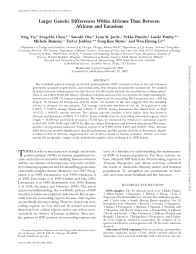



This is argument AGAINST race mixing as it shows the mixed children are less related to their parents than the non-mixed ones. Retards will try to convince you that since a child has 1/2 of your genes it doesn't matter, but it does matter - the other half counts too. I also have shown that if you race mix too much, you are basically a cuck, because it's genetically equivalent to raising someone else's kid.
Maya is a confirmed mongrel OP, not even your smartass crap will be able to prove the opposite.

Maya has green eyes, green eyes are evidence that the Aryan vril genes are strong in Maya. Maya's children can be salvaged to aryanheaven if she has them with giga aryan chad.
That's just genetic manipulation as to take useful genes from different species to create the ultimate lifeform, but it would take generations and multiple offsprings as to see noticeable results
Tldr: wait for gene editing to get the perfect tanned Aryan Maya clone
Even though genetic editing is satanic and blood is supposed to be kept pure by purging of race mixxers
Nice argument, however...
<The FST between whites and blacks is 0.23.
Oy veeeeeeeey
Exactly, don't racemix with blacks and if you must racemix (for some people it's a choice between having a mixed child or not having children at all), choose someone from a different race.

West is saved 🙏
Ok, now how can we apply this in real life? Nobody would want to hear us out, this is as esoteric as it gets.
>>58916
>You're a universalist because you see everyone as children of God, and love everyone equally.
I still don't like Jews though, they are fucking wild in the Talmud.
Internationalism is often jewish but even if its acts don't come from (((them))) it remains anti-white. Also, wdym by "everyone"? "All living beings"?
Doesn't matter, the distances between European nations are small enough you can safely ignore them.
>who cares Jesus loves you no matter what race you are
That's why cuckservatives are my enemy no. 1. Imagine how much better the world would be without this gay jewish bullshit.

>>58833
>Also I want this formula to be applied to Maya immediately
That's exactly the reason why I've made this thread (I'm obsessed or something.)
Let's divide the genes of a child into two parts: one equivalent to the genes shared by the parent with an unrelated, random person of the parent's own race, and the other one (which I will call additional genetic benefit for the lack of better term) representing the genes shared with the parent by the child in excess to what is shared with the parent by an unrelated person.
We are interested in the additional genetic benefit as it is exactly what makes parents invest in their children more than they invest in unrelated people, i.e. it is the part that makes children special from the genetic point of view.
To estimate the additional genetic benefit, denoted by the symbol (\Delta_p), let's subtract from the expected number of genes shared by the parent with his child (which, due to the fact that genes are Bernoulli distributed - meaning they are either present with some probability or not - is equal to the probability of the child having those genes) the expected number of genes shared by the parent with an unrelated person of the same ethnic origin:
(\Delta_p = p_p - p_r = 1/4 + 3/4 F_{ST} +3/4 p - 3/4 F_{ST}p - F_{ST} - p + F_{ST}p = 1/4 (1 - F_{ST} - p + F_{ST}p)).
Here, (p_p) means the probability of having the same genes with a child (or proportion of the shared genes, as it is the same), (p_r) is the same thing, but with regards to a random, unrelated person.
In the case of a mixed child we do the same thing, the only difference is in the formula for probability of having the same genes (refer to OP).
(\Delta_m = p_m - p_r = 1/4 - 1/4 F_{ST} + 3/4 p + 1/4 F_{ST}p - F_{ST} - p + F_{ST}p = 1/4(1 - 5F_{ST} - p + 5 F_{ST}p)) ((m) stands for mixed.)
Now we want to know how many mixed children given a fixation index (F_{ST}) do we need to have for it to be equivalent to having a single non-mixed child in terms of additional genetic benefit.
We get the formula (n \cdot\ \Delta_m = \Delta_{p}), from which we get (n = \frac{\Delta_p}{\Delta_m}). Let's substitute and simplify:
• (n = \frac{1 - F_{ST} - p + F_{ST}p}{1 - 5F_{ST} - p + 5 F_{ST}p});
• (n = \frac{(1 - F_{ST})(1 - p)}{(1 - 5F_{ST})(1 - p)});
• (n = \frac{(1 - F_{ST})}{(1 - 5F_{ST})}).
The formula has no (p) in it, which is amazing, because I had no idea it will be like that when I started and it allows to actually calculate the equivalent using only (F_{ST}) values, which can easily be found in tables.
Let's try with some example values. First let's assume (F_{ST} = 0.2). Then we have (n = \frac{1 - 0.2}{1 - 5\cdot0.2} = \frac{0.8}{0}), which means that no finite number of children with a person from a population distant by (0.2) would provide the additional genetic benefit, the number of required children goes to infinity.
For (F_{ST} = 0.1), roughly the distance between Whites and Asians, we get (n = \frac{0.9}{0.5} = 1.8).
Now back to the initial question. If you met an IRL Maya, how many children would you need to have with her for it to be equivalent to having a one non-mixed child? Maya is 1/4 Chinese, 1/4 Indonesian, 1/4 Indian and 1/4 Dutch, meaning that the her distance to a White person is (1/4 \cdot 0.03 + 1/4 \cdot 0.14 + 1/4 \cdot 0.13 = 0.075). Thus, the required number of children is (n = \frac{1 - 0.075}{1 - 5 \cdot 0.075} = \frac{0.925}{0.625} = 1.48), or, in other words, one child with Maya is worth about 0.68 White children.
So how many generations would have to be bleached for the next child to be white?
Yeah, it isn't that bad, you just need to make more children, it seems to be a viable alternative if you take a wife from a group with high fertility given that an average white woman would give you one child if any. But if your mixed children end up not having children themselves due to health problems, psychological problems or being rejected by potential partners, your effective reproductive success is zero. You need to take that into account.
>>59343
Depends on how you define white, but if you found the two European nations with the highest (F_{ST}), then you can easily calculate how many generations of bleaching it would take to reach that (F_{ST}).
Depends on the population you're mixing with.
>>59347
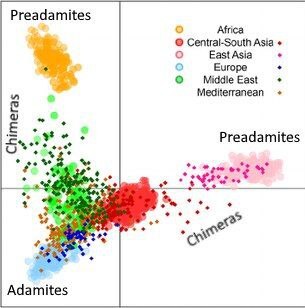
Much easier to determine Whiteness by the composition of principal genetic components, the results will still be the same.
>>59339
>her distance to a White person is <...> 0.75
Further than I had expected. It seems a random Indian would be closer.
>Further than I had expected. It seems a random Indian would be closer.
In fact it should be closer. If you check the calculation, you will notice that I put 0 as the distance to the 1/4 part that is white. That's not entirely true, as it should have negative distance (positive kinship) to a white person. The problem is that the kinship coefficient is always relative, it measures how much closer genetically a given person is as compared to a random person of an another ethnicity. The problem is that in this case I don't know what the reference ethnicity should be (she's mutted, maybe the average of Chinese, Indonesian and Indian, but I'm not 100% sure), so I left it as 0 to be on the safe side. Similar thing happens with bleaching. The distant part halves every generation and the related part grows. So the kinship grows from -Fst to 0 to 1/2 Fst and so on.
>Much easier to determine Whiteness by the composition of principal genetic components, the results will still be the same.
Maybe, the idea was to find the maximum Fst among white people. If a white person considers someone distant by this Fst white, then the same should apply to the mutts. But that's bordering on commiting Lewontin's fallacy, so I'm not sure.
Clear, namely that's why prefer to use tools such as PCA and to identify how white a person/population is.
>>59416
Sure, a random Italian would be closer to a Lebanese and further from the main White patriarch-populations (Anatolian Neolithic/Early European Farmers, Western Steppe Pastoralists, etc.) at the same time, even though he would be still White. Not to mention that during the Mesolithic period there were populations of european HGs which are very distant from modern Europeans (Western European HG, Scandinavian HG, Eastern European HG, Baltic Narva HG, etc.), although they were undoubtedly White ("much whiter" than we, even).
>>58824
>>58832
>>58834
>>58835
>>58836
>>58839
>>58842
>>58843
>>58844
>>58845
>>58865
>>58873
>>59339
>>59342
>>59347
>>58948
>>59411
>>59343
>>59347
>>59411
>>59415
>>59416
>>59420
warning of Race-mixing
>>58899
>>58898
makes you think how people may waste their lives. and>>58900 >>58902 >>58905 >>58946 >>58948
are correct she is built for hugs, nibbling, and cuddles
>>58916
>people related yay :). Jesus is Aryan
Still built for a nice caring Zaryan who really cares and encourages her to face her problems while getting her sisters to come along on her maturity arc

Ok but can you explain this with a mathematical equation? You can't? Yup, another science win

Maya is honourary so it doesn't count as racemixing

we're gonna have a lot of fun with race science in the futute
Post actions
[Return] [Thread list] [Index] [Catalog] [Top] | Replies: 73 | Views: 75 | Currently viewing: 1